

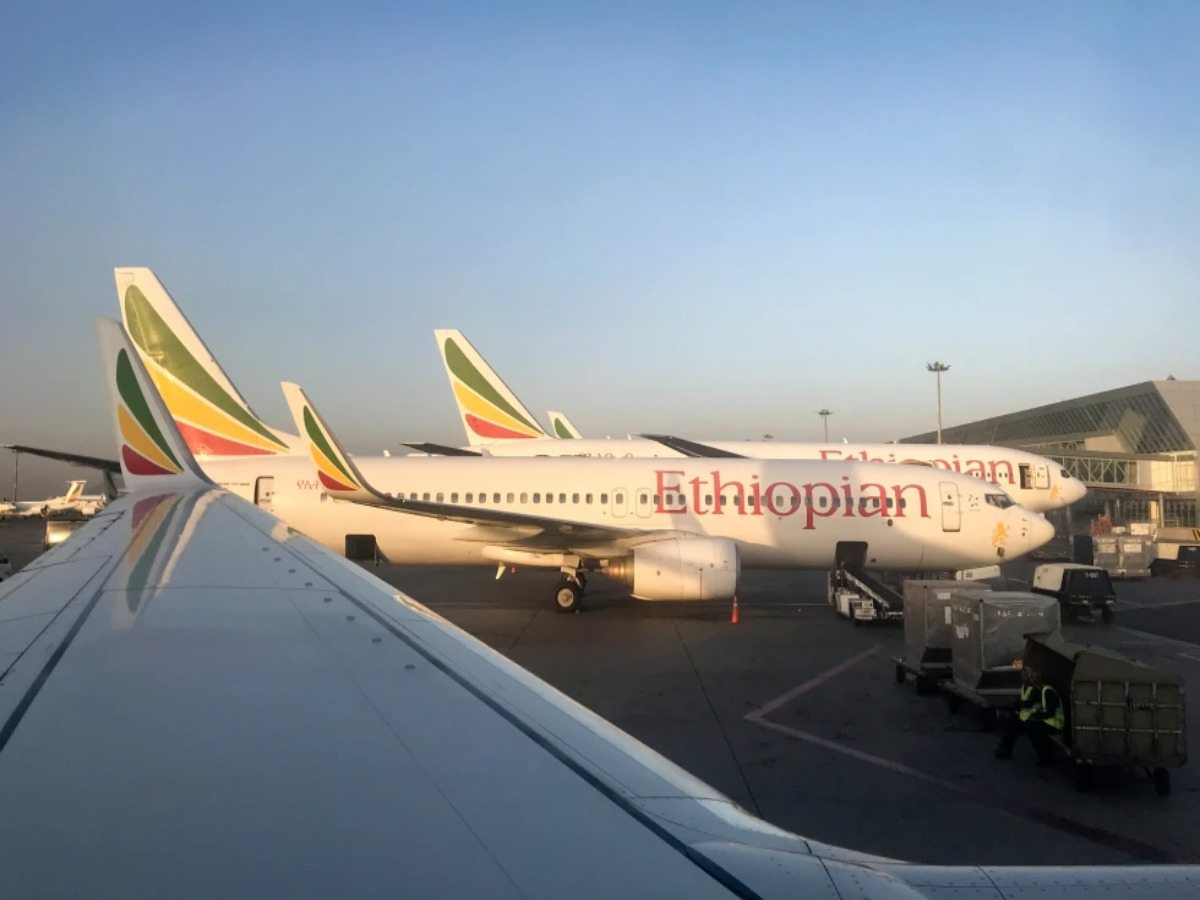
Ethiopia’s fragile calm in the north appeared to fray further this week after the country’s flag carrier abruptly halted flights to Tigray, deepening anxiety over a possible return to war.
For a second straight day on Friday, Ethiopian Airlines suspended services to and from the region, notifying passengers that the disruption was due to “unplanned circumstances.” The airline offered no further explanation, and federal authorities remained silent.
A senior figure within Ethiopia’s security services told The Associated Press on Thursday that the flight suspension was “linked to a new conflict between federal troops and the regional forces.” Speaking on condition of anonymity because he was not authorized to brief the media, the official said that “drones are hovering in the sky and there are military movements in western and southern Tigray.”



READ ALSO: Ethiopia’s Largest Airport, Diaspora Citizenship, and Cultural Loss
The flight cancellations have already triggered movement on the ground. With air travel cut off, some residents are attempting to leave the region by road.
In Mekele, the Tigrayan capital, Solomon Tadesse said he arrived early on Friday hoping to secure a bus ticket to Addis Ababa. Instead, he was told all seats were booked until next week. He now expects to wait until Tuesday to travel.
“I don’t want to face the hardships I went through in (the) past war,” he said.
The growing unease comes three years after Ethiopia’s federal government signed a peace deal intended to end the devastating conflict in Tigray. The November 2022 agreement halted two years of fighting that left an estimated hundreds of thousands of people dead.
Since then, relations have steadily deteriorated. Tigray’s leaders accuse the federal government of “openly breaching” the deal after a drone strike hit their forces last year. Addis Ababa, in turn, has accused neighboring Eritrea of mobilizing and financing armed groups in Tigray, which borders Eritrea.
Signs of panic have surfaced in urban centers across the region. In Mekele, residents queued for hours on Thursday and Friday to withdraw cash or stock up on supplies, fearing that violence could erupt again.
“I have been waiting the whole day to withdraw cash from the bank, but halfway I was told the bank has run out of banknotes,” said Bereket Ghessese.
Similar scenes were reported in Adigrat, another major town in Tigray. Genet Berhane said she arrived outside a commercial bank before dawn, only to remain in line well into the day.
“I came here at 5:30 early in the morning to withdraw banknotes. I am still waiting,” she said by phone. “The ATMs have run out of cash.”
READ ALSO: South Africa expels Israel’s top envoy as diplomatic row deepens
Concern has spread beyond the north. In the capital, Addis Ababa, some residents said the renewed tensions were unsettling.
“This time Ethiopia deserves peace,” said Gizachew Belay. “No one will benefit from war.”
At the center of the shifting regional dynamics is Prime Minister Abiy Ahmed, who has adopted a tougher tone in recent months as Ethiopia seeks access to the sea. The landlocked nation lost its coastline in 1993, when Eritrea gained independence after decades of guerrilla warfare.
Abiy has repeatedly framed the loss of Red Sea access as a strategic injustice. In September, he described Eritrea’s secession as a “mistake” that “will be corrected.” Today, most of Ethiopia’s trade flows through Djibouti, a reliance that comes with steep port fees.
Relations between Addis Ababa and Asmara have swung sharply in recent years. Abiy initially made peace with Eritrea after taking office in 2018, a move that earned him the Nobel Peace Prize. Soon after, Ethiopia and Eritrea became allies in the war against the Tigray People’s Liberation Front, or TPLF, which governs the region.
Now, the alignments appear to be shifting again. Eritrea could find itself siding with the TPLF against Ethiopian federal forces.
In May, Ethiopia’s electoral board deregistered the TPLF, citing its failure to hold a general assembly. The group rejected the decision, calling it a violation of the 2022 peace agreement. A month later, Eritrea accused Ethiopia of harboring a “long-brewing war agenda” aimed at capturing its Red Sea ports. Addis Ababa has since said Eritrea is “actively preparing to wage war against it.”
According to Kjetil Tronvoll, a professor of peace and conflict studies at the University of Oslo, a new political and security partnership may be taking shape.
“A political and security alliance between the TPLF and President Isaias Afwerki of Eritrea apparently ”is in the making,” Tronvoll said.
READ ALSO: Historic artefacts held in Germany for 100 years returned to Ethiopia
“The potential war theater is thus radically changed from what we saw in (the) 2020-2022 war, (when) Tigray was effectively surrounded by enemy forces,” he said. “This time, they will potentially have an open supply line and a support base provided by Eritrea, in addition to likely troops reinforcements.”