

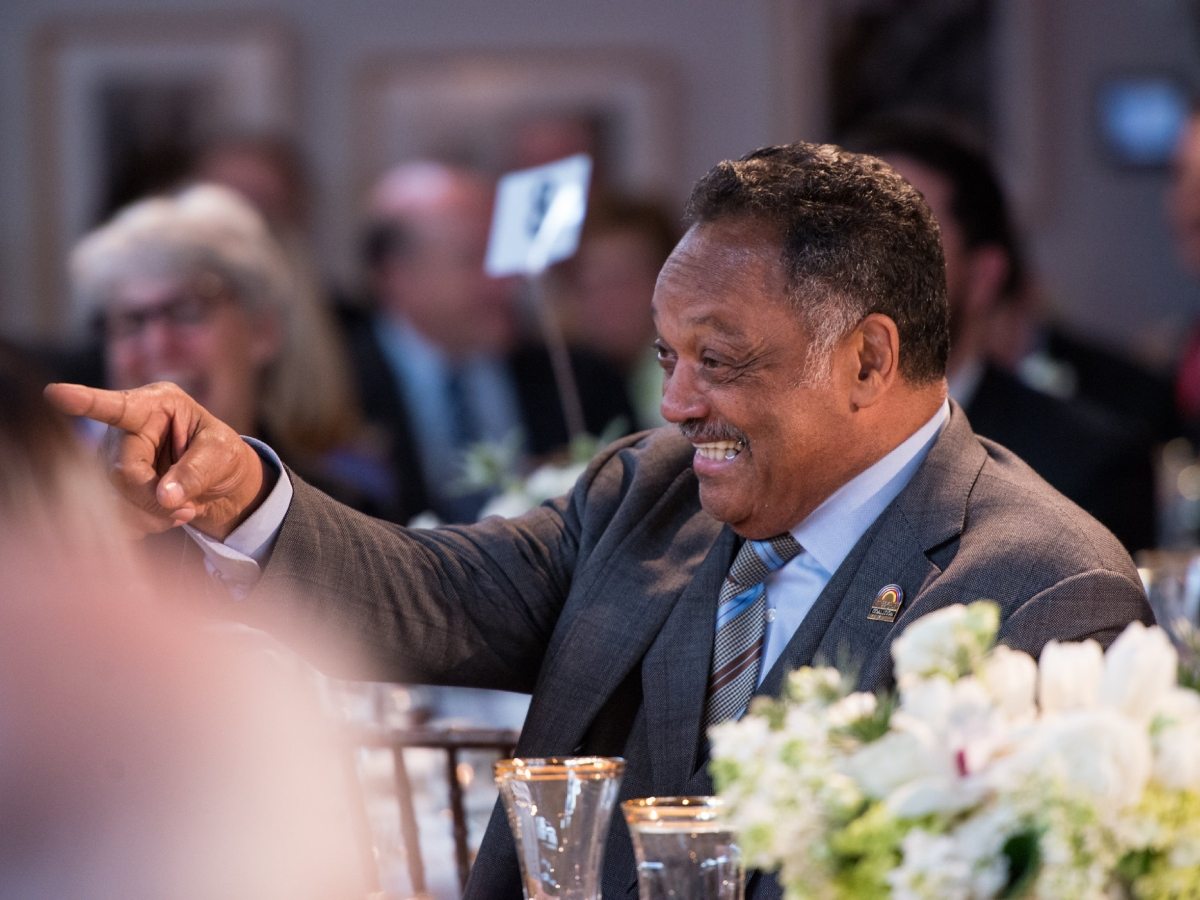
Rev. Jesse L. Jackson, an iconic figure in the Civil Rights Movement and a protégé of the Rev. Martin Luther King Jr., died Tuesday at age 84.
Jackson died surrounded by family. His cause of death has not been announced. He was recently hospitalized over a rare brain disorder that he had been diagnosed with.
Last November, his organization Rainbow PUSH said that he is “under observation for Progressive Supranuclear Palsy (PSP), a neurodegenerative disorder he has managed for more than a decade.”
Jackson’s PSP diagnosis came after he was previously diagnosed with Parkinson’s disease. Per Mayo Clinic, PSP is a “rare brain disease that affects walking, balance, eye movements and swallowing.”
Tributes have already been pouring in for the civil rights leader amid discussions about his legacy. All in all, Jackson’s fight for civil rights can be remembered through these key moments that shaped politics in America:
He started activism early
Born on October 8, 1941, in Greenville, South Carolina, Jackson started activism decades ago when he was a college freshman at North Carolina A&T. Before that, he was one of the “Greenville Eight,” a group of Black students that protested at the whites-only public library in his hometown while he was at the University of Illinois. Their protest helped ensure the library’s desegregation two months later.
When Jackson transferred to North Carolina A&T State College, he helped desegregate establishments in Greensboro before heading to the University of Chicago’s theological seminary.
Following the March 1965 incident in Selma, Alabama, in which state troopers attacked peaceful marchers, Jackson left Chicago and became a member of the civil rights movement in Selma.
He worked with Martin Luther King, Jr.
After moving to Selma, Jackson joined King’s civil rights organization, the Southern Christian Leadership Conference (SCLC), and soon began leading Operation Breadbasket, the economic development arm of the organization.
Launched Operation PUSH
In 1971, Jackson left the SCLC and launched Operation PUSH (People United to Save Humanity) to fight for economic empowerment and social justice for Black Americans and other minority groups. Operation PUSH later merged with Jackson’s Washington, D.C.-based social justice organization — the Rainbow Coalition.
The aim of the coalition to this day is to agitate for a greater share of political and economic power for African Americans and the poor, according to the Chicago Suntimes.
Jackson stepped down as leader of the coalition in 2023.
He ran for president twice
Jackson was the second Black Democrat to run for the nation’s highest office, following Shirley Chisholm’s 1972 bid.
In 1984, during his first campaign for the Democratic nomination, Jackson won 18% of primary votes, finishing third. He became the first Black politician to win any major-party state primary race, and his campaign helped reshape the Democratic Party as thousands of people were moved to register to vote.
Four years later, when he ran again, he won 29% of the Democratic vote and won 13 primaries and caucuses. Analysts said his campaign inspired a new group of Black leaders across the country, including Douglas Wilder of Virginia, who became the first Black governor of any state since Reconstruction, and David Dinkins, who was elected New York City’s first Black mayor in 1989.
Resolving disputes
Jackson traveled abroad several times in the 1970s, helping resolve global conflicts. In October 1997, President Bill Clinton named Jackson his special envoy for democracy and human rights in Africa. In this role, he made several trips to Liberia, Kenya, Zambia, Guinea, Sierra Leone, Ghana and Nigeria, helping to strengthen their democratic process while resolving disputes and enhancing good governance.
In 1999, Jackson brokered the release of U.S. soldiers held in Kosovo before helping in the release of four British journalists held by Liberia in 2000.
More than a decade before this, Jackson negotiated the release of Navy Lt. Robert Goodman in 1984 after being captured by Syria.
For almost 30 years, Jackson served as a high-profile political figure, playing a significant role in nearly every U.S. movement for empowerment, peace, civil rights, gender equality, and economic and social justice. However, his health challenges began affecting his work. In August 2000, Clinton awarded Jackson the Presidential Medal of Freedom, the nation’s highest civilian honor.