

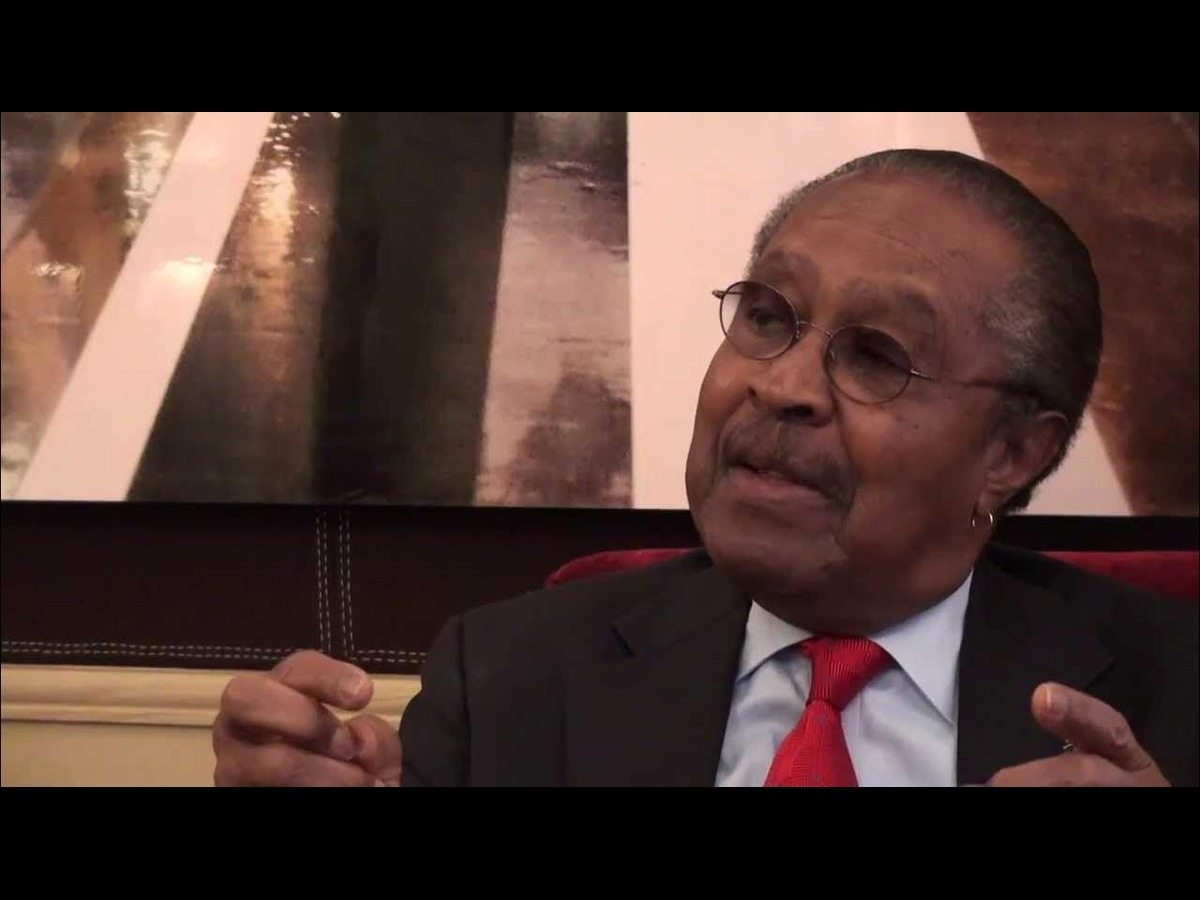
In February 1960, Clarence B. Jones received a phone call from a friend who informed him that a Georgia preacher, Martin Luther King, Jr., had been indicted for tax evasion. The friend, Hubert Delany, had asked Jones if he would like to join him on the legal defence of the civil rights leader and preacher in Alabama.
Jones was, at the time, a 29-year-old copyright lawyer who had just moved to California and was living a comfortable life. He did not believe his friend’s words that King was being accused wrongly of not paying his taxes. So, Jones told his friend that he wasn’t interested in the case and shouldn’t be expected in Birmingham to help.
The following day, King himself was at Jones’ door in California. Still, Jones refused to help. “Just because some preacher got his hand caught in the cookie jar stealing, that ain’t my problem,” Jones later told his wife.
But Jones accepted an invitation to hear King preach at a church in Baldwin Hills, California. That sermon would change his life.
While seated at the church, mesmerised by King’s delivery, Jones realized later that he was now the subject of the sermon, though his name wasn’t mentioned. King began speaking about a skilled Black lawyer who had declined to join the movement — a decision the lawyer’s mother would be shocked to hear.
King, having earlier known from Jones that his parents worked as domestic servants, then read from Langston Hughes’ poem Mother to Son, about a mother’s difficult journey. Jones started tearing up.
After the service, he asked King: “When do you want me to come to Birmingham?”
Not too long after, King was found not guilty of tax evasion. Jones became King’s personal attorney, adviser, draft speech writer and fundraiser, who was seen at various historic events of the civil rights movement. One of the things he cherishes most about his work with King was that a huge part of his own writing made it into King’s landmark “I Have a Dream” speech.
More than 60 years after working with King, Jones, now 95, recently became the subject of The Baddest Speechwriter of All, a new documentary short that was awarded the Sundance Film Festival’s Short Film Grand Jury Prize in January. The 29-minute film, which Netflix has acquired, looks at Jones’s work with the Civil Rights Movement and the challenges he faced.
NBA star Stephen Curry, making his directorial debut, worked with Oscar-winning filmmaker Ben Proudfoot to tell Jones’s story and his work with King.
Curry and another producer of the film, Erick Peyton, said, “We couldn’t be more excited that The Baddest Speechwriter of All has found a home with Netflix. Dr. Jones’ story has long deserved this level of reach and recognition.”
Born on January 8, 1931, in Philadelphia, Pennsylvania, Jones’ parents, Goldsborough and Mary, worked as domestic servants for the Lippincotts, a wealthy white family in Philadelphia. Jones was sent to a de facto orphanage run by Irish Catholic nuns because his parents’ employers declined to help with lodging and other resources, as reported by the Guardian. Despite being away from his parents most of the time, Jones understood their decision. Afterall, that decision helped him become a gifted student.
“What mother knowingly does that because she wants her son to have a better life?” he said to the Guardian in an interview. “A mother that loves her child beyond rational description.”
From the Catholic boarding school in New England, Jones attended Palmyra High School, where most of his peers were white. He became first clarinet in the New Jersey All-State Orchestra and graduated as valedictorian in 1949.
That same year, he entered Columbia University under a scholarship and financial assistance program and became one of the only Black students at the school. Following his graduation, Jones was drafted into the Army and was stationed for almost two years at Fort Dix. He then studied law at Boston University and began working for Revue Productions as associate general counsel.
He had been working in entertainment law for just a year when King showed up at his door. He would later tell King and the Southern Christian Leadership Conference (SCLC) that following their principles of non-violence would be very difficult for him.
Even though he changed this position years later, the SCLC asked him to work behind the scenes instead of joining frontline demonstrations.
Helping to raise funds for the movement while serving as King’s attorney, speech writer and adviser, Jones helped smuggle out King’s famous “Letter from a Birmingham Jail”. From the Birmingham jail, where King had been imprisoned as a participant in nonviolent demonstrations against segregation, he wrote in longhand a letter responding to a public statement of caution by eight white religious leaders of the South.
King’s Letter from Birmingham Jail is still very important today and is read annually on the floor of the US Senate.
Jones said to the Guardian that writing the letter “was probably what enabled him [King] to almost ignore he was in solitary confinement.”
“He was so concentrated on responding, he meticulously wanted to answer [the open letter]. He had no books, nothing to refer to, but in reading the actual letter you would think he had a library.”
Jones went on to help King write many of his speeches, as King trusted him. “If you’ve got somebody who has a musical background becomes a speechwriter, you’ve got the baddest speech writer of all,” Jones says in the film. “So when I was writing words it was like writing musical notes.”
Jones is behind the opening words of King’s powerful speech at the March on Washington in August 1963. The two had shared ideas for the speech before Jones wrote some text on yellow paper for King to consider. He was shocked when those words became the first seven paragraphs of King’s address.
He heard the King deliver the words verbatim, without editing them, in front of more than 250,000 people at the Lincoln Memorial.
“Five score years ago, a great American, in whose symbolic shadow we stand today, signed the Emancipation Proclamation. This momentous decree came as a great beacon light of hope to millions of Negro slaves who had been seared in the flames of withering injustice. It came as a joyous daybreak to end the long night of their captivity. But 100 years later, the Negro still is not free.”
King would later go off script to deliver what Jones calls in the film the “greatest jazz rip of all.”
The civil rights leader began “I have a dream” after being urged on by gospel singer Mahalia Jackson, who had called from the audience: “Tell them about the dream, Martin.”
Jones recalled what happened next. “Like a musician, like Charlie Parker showing he’s about ready to let go – that’s when I knew that something special was coming.”
“It was as if some spiritual unseen force took over his body. His body was there, but something had taken possession of it. I had seen him speak so many times before. But I never heard him speak like that.”
Jones further helped to draft other notable speeches of King, including the anti-war speech Beyond Vietnam. At the time of King’s assassination, Jones had also become the first Black investment banking partner on Wall Street.
He left the SCLC following King’s death because he “couldn’t take it any more,” he said. “The SCLC without Martin was just too painful for me to bear.”
“I went crazy,” he added. “Martin finally got me committed to non-violence and now they kill him.”
Jones received the Presidential Medal of Freedom from then-President Joe Biden in 2024.
“Jones wielded a pen as a sword and gave words to the movement that generated freedom for millions of people,” said Biden during the ceremony.
“He helped define the enduring ideas included in the ‘Dream’ that will be ever forever engraved in the ethos of America. … Thank you, Dr. Jones.”