
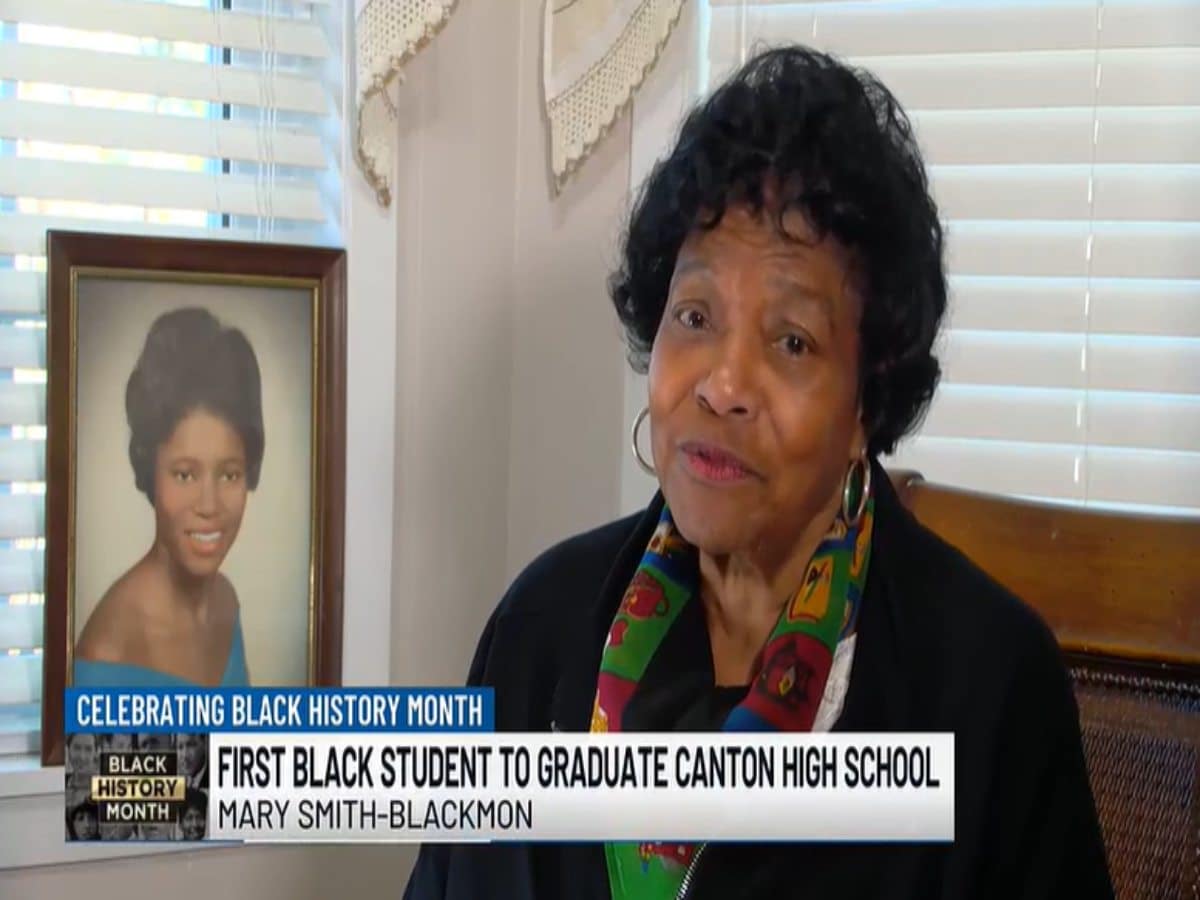
Sixty years ago, Mary Smith-Blackmon was one of the students who pioneered the integration of Canton High School. Along with Bobbie Ruth Chinn and Phill George, she transferred from Rogers High, the Black high school across town, to the predominantly white public school in 1965.
Reflecting on their journey, Smith-Blackmon recalled the violence that met them on their first day at the school.
“We tried to walk down the main walk into the building. We got hit with a few little items. They threw and they hit us with acorns that fell from those draping trees that were there, but we got in,” Smith-Blackmon told WLBT.


Inside the classroom, the harassment persisted.
“They sprayed my chair; they sprayed all around me with whatever it was. Then when the teacher came in, they were all laughing and noisy. Then when she walked in, they all got in their seats and were quiet. But I wasn’t sure what I was sprayed with,” Smith-Blackmon recounted.
The three students were kept apart by school officials.
“Bobbie Chinn and I didn’t have any classes together. They made sure that we would be all alone, all the time,” Smith-Blackmon said.
Smith-Blackmon was suspended during a school program in the auditorium after staff were told she started a fight. She stated that the incident began when a male student behind her repeatedly kicked her chair.
“I just told him, as long as you are white and I’m Black, don’t you ever put your feet anywhere near me. He ran to the office and told it, and they came and got me out of class and I got a suspension. I think it was like two weeks. They touched me first, pushing my chair,” Smith-Blackmon explained.
The request by the three Black students to return to Rogers High was denied by officials.
“We asked if we could transfer back. We were transfer students and they say and we wanted to know if we can go back to Rogers and they said no. I was so disappointed,” Smith-Blackmon said.
Due to state law, students were limited to only one transfer per school year. Eventually, this led to Chinn withdrawing and George’s family relocating out of state. As a result, Smith-Blackmon was left to continue the effort alone.
“We didn’t know then, how bad it was going to be. We just thought it would go away, but it didn’t go away though,” Smith-Blackmon said.
A white classmate unexpectedly provided Smith-Blackmon with support as graduation approached. Smith-Blackmon described this person as being “like an angel,” consistently looking out for her.
Smith-Blackmon received only five graduation tickets for her family, an insufficient number, but her classmate assisted her.
“She passed me an envelope, and she said take these tickets, but you must never tell where you got them from…and to this day, publicly, I’ve never told who gave me the tickets,” Smith-Blackmon said.
Out of respect for the classmate’s family, Smith-Blackmon chose not to name her classmate, who has since passed away due to complications from diabetes.
READ ALSO: How America forgot 5-yr-old Sarah Roberts, who first fought for school integration
Smith-Blackmon graduated with honors in May 1966.
“We got through it. That’s God. We got through it. We made it. Other people and other students could benefit from that. So, that makes me feel really good about that but, for a long time, I don’t think the people in Canton paid that much attention to the situation,” Smith-Blackmon said.
Smith-Blackmon continued her schooling at Tougaloo College and later Jackson State University, majoring in education. After graduating, she devoted over three decades to the Canton Public School System before her retirement.
The former Canton High School closed permanently in 1969. In its place, new institutions such as Canton Academy were established. A.M. Rogers High School was subsequently officially renamed Canton High School.
Despite the passage of time, Smith-Blackmon recognized individuals from her challenging senior year when she looked through her 1966 Canton High School yearbook; some of those faces belonged to people who had made that year difficult for her.
“I see some I know… I see the ones that stomped at me, kicked at my chair,” Smith-Blackmon said.
Smith-Blackmon takes pride in her role as a catalyst for change, regardless of the challenges she faced.
“We needed people to do that. It was hard, but what we have to remember is that opportunity follows struggle. If nobody is out there to struggle, then opportunities don’t come,” Smith-Blackmon stated.