
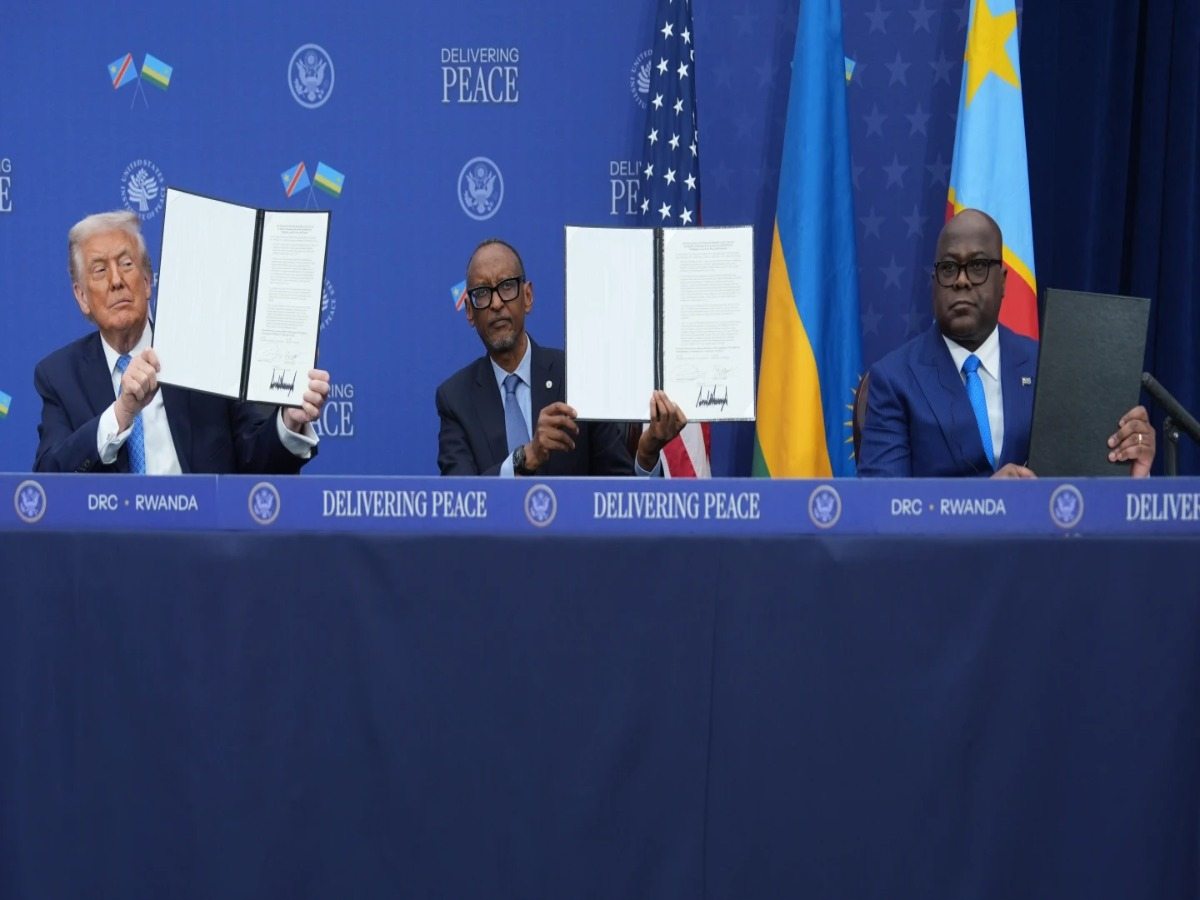
President Donald Trump placed himself at the center of a high-profile diplomatic moment on Thursday as he welcomed the leaders of the Democratic Republic of Congo and Rwanda to Washington for the signing of an agreement the White House hailed as a historic step toward easing the conflict in eastern Congo. Trump celebrated the pact as evidence of his global negotiating prowess and as further justification for the Nobel Peace Prize recognition he has long sought.
Trump praised both President Felix Tshisekedi of Congo and President Paul Kagame of Rwanda for agreeing to move forward with a process aimed at ending years of unrest in a region rich in minerals critical to U.S. industries. Tagging the event as a rare breakthrough, he told the audience, “It’s a great day for Africa, a great day for the world.” He added, “Today, we’re succeeding where so many others have failed.”
The ceremony drew African officials to Washington at the same time Trump was criticizing Somalia and declaring he did not want immigrants from the country entering the United States. Even so, the administration showcased the signing as the culmination of months of diplomatic involvement by the United States, the African Union and Qatar, building on a June framework between the two Central African nations.
RELATED STORIES

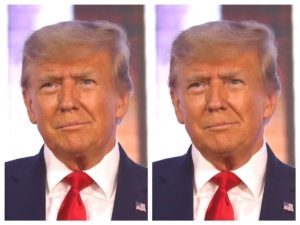
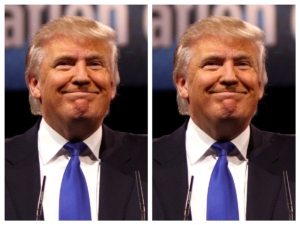
Nonetheless, the peace Trump highlighted remains tenuous. Congo’s long-running conflict involves more than 100 armed groups, including the Rwandan-backed M23 rebels. Their rapid advance this year captured the key cities of Goma and Bukavu and deepened what was already one of the world’s most severe humanitarian crises. Reports continued this week of skirmishes involving M23, Congolese forces and allied militias, stressing how far the region remains from stability. Trump has repeatedly claimed his mediation has ended the conflict, a statement many in Congo dispute.
READ ALSO: Trump administration freezes green cards and immigration for 19 “high-risk” nations
Despite ongoing clashes, Kagame and Tshisekedi struck an optimistic tone during the ceremony. Kagame said, “No one was asking President Trump to take up this task. Our region is far from the headlines. But when the president saw the opportunity to contribute to peace, he immediately took it.” Tshisekedi called the moment a demanding but necessary turning point, saying, “I do believe this day is the beginning of a new path, a demanding path, yes. Indeed, quite difficult. But this is a path where peace will not just be a wish, an aspiration, but a turning point.”
Analysts argue the pact is unlikely to produce rapid improvements. Congo has also negotiated a separate agreement with M23, and residents say nothing on the ground feels settled. “We are still at war,” said Amani Chibalonza Edith, a 32-year-old resident of Goma. “There can be no peace as long as the front lines remain active.”
Trump, however, predicted a dramatic shift, saying the two countries would move past “decades of violence and bloodshed” and enter “a new year of harmony and cooperation.” He added, “They spent a lot of time killing each other. And now they’re going to spend a lot of time hugging, holding hands and taking advantage of the United States of America economically like every other country does.”
Notably, Tshisekedi and Kagame avoided eye contact and did not shake hands during the 50-minute event, AP reported.
READ ALSO: Trump administration targets SNAP management funds in fight over state records
The agreement is designed to build on a previously established Regional Economic Integration Framework that outlines long-term economic collaboration between Congo, Rwanda and the United States. Trump also announced that the United States had finalized bilateral agreements with both African nations, granting greater access to critical minerals and promising economic gains for all three countries. “And we’ll be involved with sending some of our biggest and greatest U.S. companies over to the two countries,” Trump said. He added, “Everybody’s going to make a lot of money.”
The United States’ interest in Congo’s mineral wealth has grown as the former tries to lessen its dependence on China for rare earths used in smartphones, military aircraft and other advanced technologies. China currently leads global rare earth mining and processing.
Before the signing at the Institute of Peace, recently renamed by the State Department as the Donald J. Trump Institute of Peace, Trump hosted private meetings with Tshisekedi and Kagame at the White House, followed by a three-way discussion.
While the leaders met in Washington, residents in eastern Congo reported fresh clashes across several communities. Both M23 and Congolese forces accused each other of breaking the ceasefire established earlier in the year, and violence persisted in South Kivu’s central plateaus.
Conditions for civilians have worsened following significant U.S. aid cuts. In Goma, once a major hub for humanitarian operations, the airport remains closed. Basic services, including banks, have not reopened, and residents say crime and prices have surged.
The roots of the crisis stretch back to the aftermath of Rwanda’s 1994 genocide, when nearly 2 million Hutus fled into Congo as Tutsi-led forces regained control. Rwanda argues that remnants of the militias formed by some of those who fled continue to threaten its Tutsi population. Congo maintains that Rwanda must halt its military and logistical support for M23 if a durable peace is to take hold. United Nations experts estimate that thousands of Rwandan government troops are operating in eastern Congo alongside M23, an allegation Rwanda rejects while insisting its actions are focused on protecting its territory.