
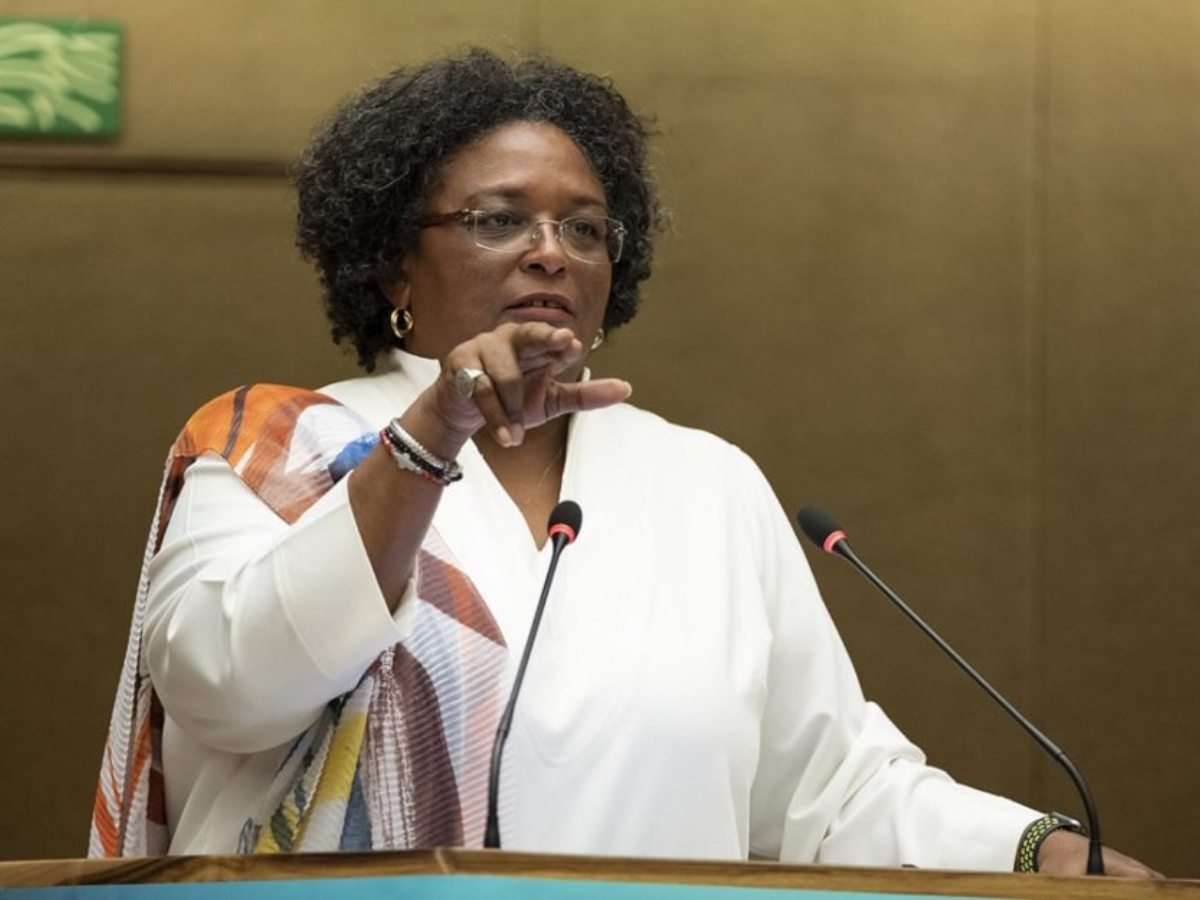
Barbados Prime Minister Mia Mottley has once again demonstrated her global impact, being named one of the World’s 100 Most Powerful Women by Forbes in 2025. At No. 99, she joins a select group of powerful political, business, and humanitarian leaders who are actively shaping the future globally.
Forbes’ choice of Prime Minister Mottley comes from her ongoing and extensive international influence. Her Forbes profile points to her smart diplomacy and her key role in guiding Barbados through its historic change to a constitutional republic in 2021 as reasons for her high ranking.
Her political career, which would eventually bring her to regional and international prominence, began in 1994 with her first ministerial appointment as Minister of Education, Youth Affairs, and Culture. Her short biography in the Forbes piece also repeats her political success as Barbados‘ first female Prime Minister after her 2018 win.
RELATED STORIES


READ ALSO: Five things to know about Mia Mottley, Barbados’ first female prime minister
More recently, she has become a key world leader on the urgent issue of climate change, getting international notice. Her important role is clear from her “powerful speech” at the 2021 United Nations General Assembly, calling for urgent action.
The United Nations Environment Programme recognized her as a “Champion of the Earth for Policy Leadership” in that same year. Moreover, Forbes highlights her involvement in the significant constitutional change Barbados underwent.
“Under her leadership, in November 2021, Barbados officially became a parliamentary republic and removed the Queen of England as its head of state.”
Mottley’s inclusion places her among a global cohort of women shaping economies, diplomacy, technology, philanthropy, and cultural influence.
Political figures dominate the 2025 Power Women list, with the top three spots occupied by European Commission President Ursula von der Leyen (No. 1), European Central Bank President Christine Lagarde (No. 2), and Japan’s first female prime minister, Sanae Takaichi (No. 3).
Additionally, Forbes acknowledged six influential African women in its 2025 ranking, according to Africa News.
Judith Suminwa Tuluka – Democratic Republic of Congo
Judith Suminwa Tuluka became the DRC’s first female Prime Minister in June 2024. An economist and public finance expert, she previously served as Minister of State and Planning, with a background at the UNDP. Her expertise covers budgeting and national coordination.
Netumbo Nandi‑Ndaitwah – Namibia
Netumbo Nandi-Ndaitwah was sworn in as Namibia’s first female president on 21 March 2025. The veteran politician and former Vice President has held major roles, including minister of foreign affairs. Since taking office, she has worked to stabilize policies and reduce public debt.
Mpumi Madisa – South Africa
Mpumi Madisa is the first Black woman CEO of a Johannesburg Stock Exchange top-40 company. She became CEO of Bidvest in October 2020, having advanced through sales and marketing roles. Under her leadership, the company restored profitability, expanded globally, and manages about 130,000 employees.
Ngozi Okonjo‑Iweala – Nigeria
Ngozi Okonjo-Iweala, a prominent economist, is serving her second term as Director-General of the World Trade Organization (WTO). She was the first woman and first African to lead the WTO, starting on 1 March 2021, and has held senior roles at the World Bank and chaired Gavi.
Mo Abudu – Nigeria
Mo Abudu, founder of EbonyLife Media, is a major African cultural leader. Named one of TIME’s 100 most influential people in 2025, she recently launched the $50 million Afro Film Fund and expanded her media presence to the United Kingdom with EbonyLife Place London.
The 22nd annual Forbes ranking assessed 100 women from 17 countries based on four key metrics: money, media, impact, and spheres of influence. Collectively, these women wield an estimated $37 trillion in economic power and affect the lives of over a billion people.
READ ALSO: Forbes’ 2025 World’s Black Billionaires list: Here are the top 10