

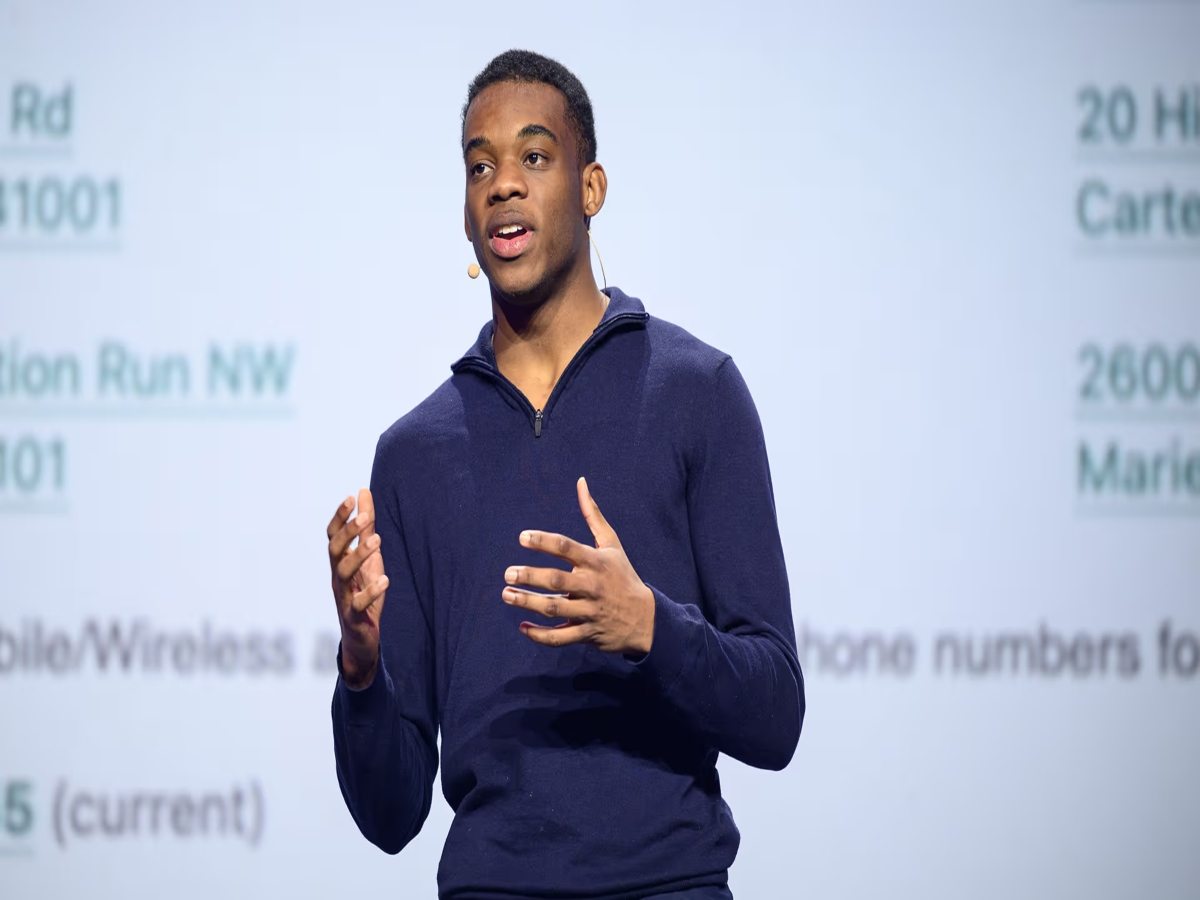
Caine Ardayfio recently secured $6.6 million for his company, Mira, following a successful seed round led by General Catalyst.
The 22-year-old decided to put his Harvard University studies on hold to focus completely on his new project, Mira.
This venture involves AI-powered smart glasses, described as a transformative piece of wearable technology. The technology is designed to “sit in on your conversations,” with the goal of “help[ing] make you smarter throughout the day.”


Ardayfio’s vision is to integrate the Mira AI glasses into daily life. To achieve this, the recently secured funding will be used to improve the hardware’s consistency in texture and thickness.
According to Ardayfio, this funding has “supercharged” the company’s advancement. The investment is earmarked to support a team of top-tier software engineers and machine learning experts. These experts will be crucial in developing the app, AI systems, and the glasses’ firmware to guarantee the system’s seamless operation.
READ ALSO: Nigerian Tech Founder Tope Awotona Who Revolutionized Global Scheduling
“I think that software’s going to be the big thing. The hardware for smart glasses has been around for a while, but the software has always been the part that’s been so bad,” he told AfroTech. “I think that’ll be like the real distinguishing factor for us is getting a really great software and AI experience.”
Ardayfio co-founded the company with Anh Phu Nguyen, whom he first met at the Harvard makerspace. Their collaborative projects there, including flamethrowers, robotic tentacles, and smart glasses, garnered 80 million views and laid the groundwork for their current company, Mira, according to a press release.
Mira AI glasses capture audio but not video, featuring infinite memory and instant AI-driven answers, according to the company’s website.
The technology boasts several capabilities, including real-time translation into over 60 languages, instant mathematical calculations, comprehensive conversation recall, and the ability to ask follow-up questions, which are displayed on the glasses.
While the glasses lack a camera and thus cannot store video, and the original audio is instantly deleted, transcriptions of conversations are stored and accessible via the companion app. The app supports all core functions with a free version, but an optional $20 subscription is available for unlimited AI responses.
“We try to make sure it’s as private as possible,” Ardayfio explained.
The AI glasses, available for $649 (non-prescription) and $799 (prescription), include built-in speakers and an optional ring. The ring can activate the AI and answer calls, but the glasses function with or without it. Additionally, users can use the accompanying app to review their day, quickly locate specific moments, and personalize their AI.
The glasses have been mainly bought by “older customers, such as executives or business owners, who want to monitor the content of their meetings.”
Ardayfio told AfroTech, “I think with what these glasses do is they let you be much, much closer to the AI systems, where rather than, you know, it just being another browser tab that you go into, it’s literally like a system that’s with you 24/7. It’s with you during all of your conversations, and you’re able to like talk to it and like interface with it much, much faster without even pulling out your phone.”
He continued, “That’s the shift that we’re trying to make with the system. And we’re obviously starting with a lot of business owners and executives who are using this throughout their high-intensity conversations. But we wanna bring this to the masses with time, and I think that’ll come with like the calendar integrations and email.”
The initial market release will consist of 300 glasses, with an additional 1,000 scheduled for release by the end of January. Ardayfio aims to grow the Mira customer base to one million within the next three years.
Ardayfio began coding in eighth grade after his father introduced him to it, and today, he has become a formidable force in the tech industry.
From a young age, his passion for technology drove him to create various websites and apps, even delving into ethical hacking. During his senior year of high school, he launched his first startup, an idea inspired by his sister that focused on mental health.
At the time, he successfully raised $100,000 for the venture and hired a small team.
READ ALSO: How Crystal Brown co-founded biotech company CircNova without having ever studied biology