

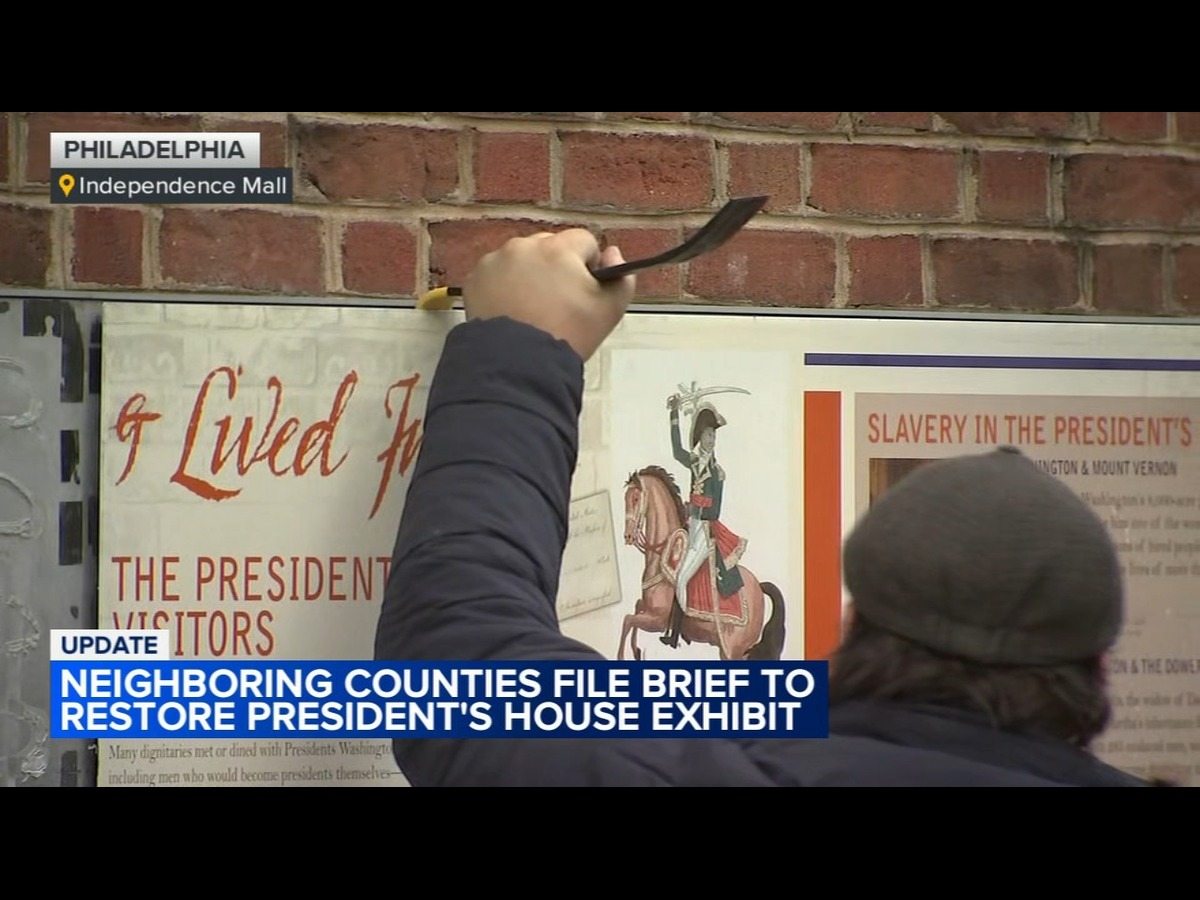
An exhibit about people enslaved by George Washington, the first president of the United States, must be restored at Washington’s former home in Philadelphia, a federal judge ruled Monday.
The ruling came after the city of Philadelphia sued President Donald Trump’s administration after the National Park Service took down explanatory panels and a video installation from the Independence National Historical Park, the site where Washington lived with his wife in the 1790s. The exhibit opened in 2010 and paid tribute to the nine people enslaved by the Washingtons at the site.
The National Park Service removed the exhibit after Trump signed an executive order in March 2025, “restoring truth and sanity to American history” at the nation’s museums, parks and landmarks. The Interior Department must also see to it that the sites do not display elements that “inappropriately disparage Americans past or living”, per the order.


U.S. District Judge Cynthia Rufe’s ruling on Monday stated that all materials related to the Philadelphia exhibit must be restored in their original condition while a lawsuit challenging the legality of the removal is underway. Rufe, who gave the ruling on Presidents Day, the federal holiday honoring Washington’s legacy, also warned Trump officials not to install replacements that explain the history differently.
In her 40-page decision, Rufe accused the federal government of trying to erase U.S. history, much like the fictional authoritarian regime that ruled George Orwell’s dystopian novel 1984.
“As if the Ministry of Truth in George Orwell’s 1984 now existed, with its motto ‘Ignorance is Strength,’ this Court is now asked to determine whether the federal government has the power it claims – to dissemble and disassemble historical truths when it has some domain over historical facts,” Rufe wrote. “It does not.”
Trump had targeted several sites in Philadelphia, quietly removing content about slavery, LGBTQ+ people and Native Americans.
This month, the National Park Service removed a rainbow flag from the Stonewall National Monument, where an uprising started following a police raid on an underground gay bar, the Stonewall Inn. That historic 1969 uprising sparked the modern LGBTQ+ rights movement.
Trump officials also ordered that the signage at Little Bighorn National Monument in the state of Montana be changed.
The signage describes “broken promises to Native American tribes” and makes reference to “the loss of Indigenous culture and language under boarding school systems.”
Black community leaders and local politicians welcomed Monday’s ruling. “I’m proud of our country and its founding ideals. That means we tell the full truth about our history, the good and the bad,” said State Representative Brendan Boyle, who represents Philadelphia.
Meanwhile, the Department of the Interior has officially appealed the federal judge’s order to restore the slavery exhibit.