

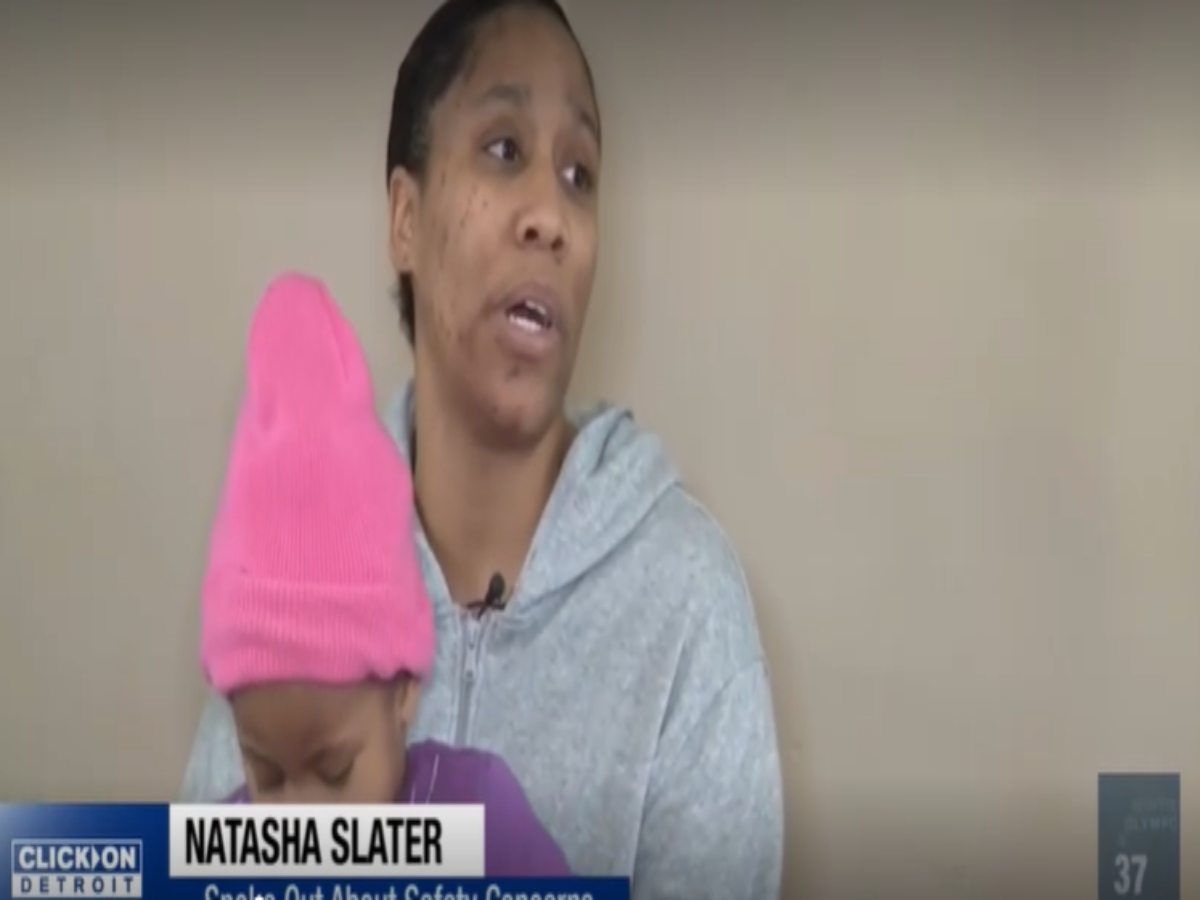
Natasha Slater is now breathing a sigh of relief after her attempt at highlighting an alleged problem at the Detroit Rescue Mission and Ministries women and children’s shelter backfired, almost leaving her and her daughter homeless.
Slater has now spoken on the record with Local 4 and provided a recording of the moment she was told to depart the shelter.
“I was just trying to step up for us as mothers because at the end of the day, we still human beings, we still have feelings,” Slater told the outlet.
RELATED STORIES



The unfortunate incident allegedly occurred after she gave an anonymous interview to Local 4, raising safety concerns about the facility. At the time, she told the outlet that the shared bathrooms at the shelter did not have locks and that men were living inside the facility.
READ ALSO: Family of 6 homeless after falling prey to apartment scam
The outlet then gained entry to the shelter to speak with its CEO, Dr. Chad Audi. “Is this a women and children’s shelter?” the outlet asked. “Yes, women and children,” Audi responded.
“So there are no men?” Local 4 asked. “There is if they are married,” Audi said. “How many dads are here?” the news source inquired. “Maximum we ever had was five,” Audi answered.
“So how do I lock that? Can you lock that?” the news representative asked while trying to lock the shared bathroom door.
“We don’t lock the rooms because there’s children,” a shelter staff member said.
After Local 4 published the story, Slater grew concerned that shelter staff might identify her as the source of the information. Just as she feared, she was called into a meeting with the leadership.
However, before that, a shelter representative approached Slater to discuss an incident involving another resident and a concern related to her daughter. The situation escalated, and Slater captured the discussion on tape.
“People are scared. People are scared because the news been up here,” a staff member said on the recording.
Slater explained that the staff members were concerned about the person exposing them, worrying that it might lead to them losing their jobs.
Days after the interview, Slater was told she had to leave the shelter by noon. She then informed a friend, who contacted the police.
When the police arrived, Natasha said the shelter altered its account, telling officers she could simply be moved to another room within the same facility or transferred to a different shelter run by their organization.
In a statement to Local 4, the shelter insisted that the offer they made was their standard practice all along.
“They changed it as soon as the police came and everything, they changed it up,” Slater recounted. “I was just shocked because they just told me I couldn’t stay, so I am confused. The police said ‘well let me go talk to them.’ Miss Lawrence kept saying ‘you can stay, we don’t want you to be homeless.’ I’m like, that was weird because you all were just telling me I had to be out by noon.”
Despite moving to a different location within the shelter for the night, Slater remained nervous for her safety.
The following morning, she received the welcome news that Detroit Power Detroit Community Outreach had secured accommodations for her. Two hours later, she left the premises.
“I’m just happy,” she said. “I am just happy to be in a better environment. It’s a relief for me and my baby.”
The Detroit Rescue Mission Ministries (DRMM) issued a statement to address the concerns about room arrangements raised by the resident.
According to the DRMM, “In response to her expressed concerns, and consistent with our standard practices, she was offered two options: relocation to a different room within the same shelter with no shared bathroom, or transfer to another Detroit Rescue Mission Ministries location. The resident chose to move to a different room, and this request was immediately granted.”
Subsequently, the resident made a self-initiated transition to Detroit Power, a separate organization providing a two-year transitional housing program, rather than emergency shelter services.
The organization explicitly denied any suggestion of retaliation due to media involvement, stating their actions were guided solely by resident dignity, safety, and appropriate program placement.
Citing privacy protections, the DRMM stated it could not comment further on individual case details, but “We stand by the facts outlined above and expect them to be reflected accurately.”
READ ALSO: Local organizations help Atlanta mom, son get new apartment after battling homelessness