

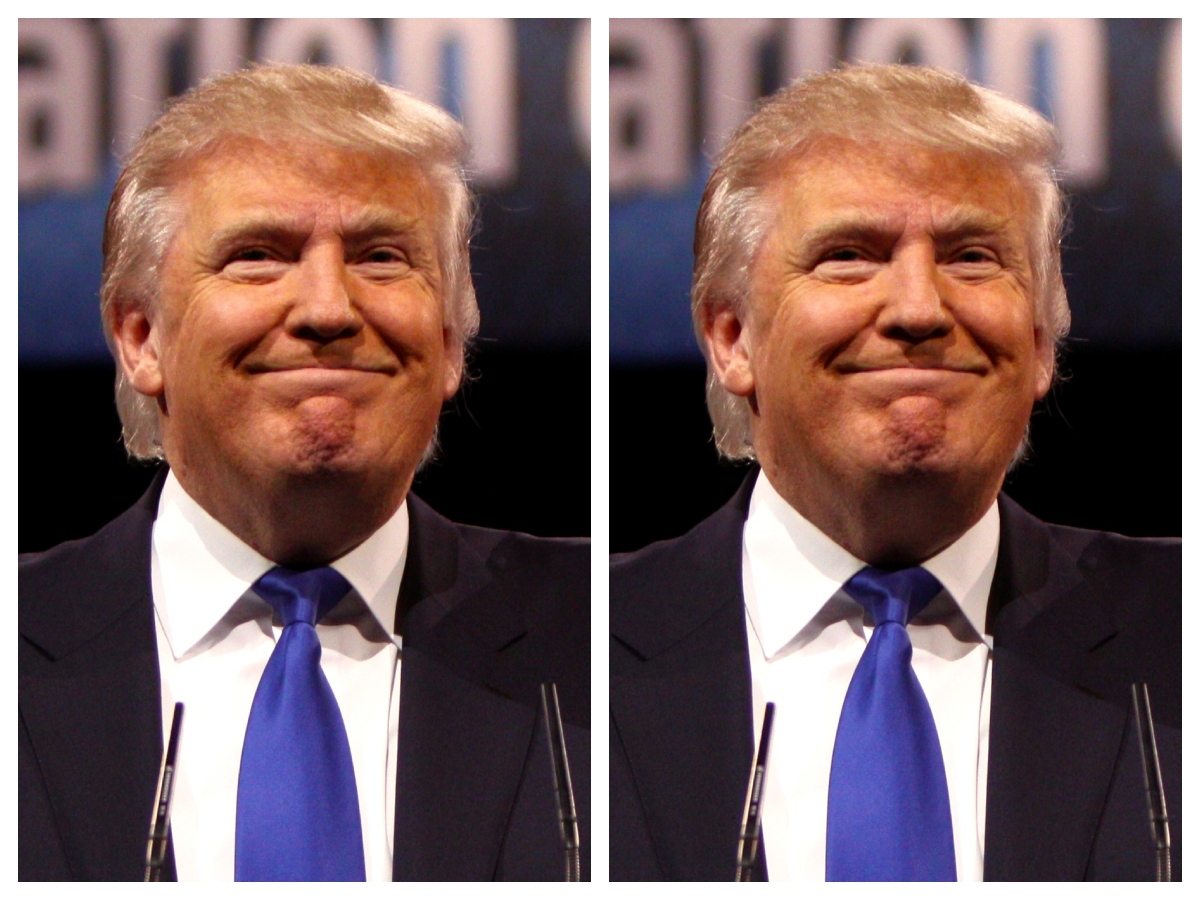
President Donald Trump on Saturday threatened extensive new tariffs against eight European countries, linking the proposed trade penalties to their resistance to U.S. control of Greenland in a move that could significantly strain transatlantic relations.
Trump said goods imported from Denmark, Norway, Sweden, France, Germany, the United Kingdom, the Netherlands, and Finland would face a 10% tariff beginning in February. Posting on social media from his golf club in West Palm Beach, Florida, he warned the rate would rise to 25% on June 1 unless an agreement was reached on what he called “the Complete and Total purchase of Greenland” by the United States.
The president’s comments suggested the tariffs were intended to pressure Denmark and other European governments into negotiations over Greenland, a semiautonomous Danish territory and NATO ally that Trump has repeatedly described as vital to U.S. national security.



READ ALSO: Trump floats tariff penalties to force support for U.S. control of Greenland
“The United States of America is immediately open to negotiation with Denmark and/or any of these Countries that have put so much at risk, despite all that we have done for them,” Trump said on Truth Social.
The threat represents a potential rupture with some of the United States’ closest allies, adding stress to the NATO alliance that has underpinned European and North American security since 1949. Trump has frequently used tariffs as leverage in foreign policy disputes, a strategy that has extracted concessions from some governments while provoking resistance from others, including China.
The timing of the announcement is particularly sensitive, with Trump scheduled to attend the World Economic Forum in Davos, Switzerland, on Tuesday. European leaders targeted by the tariff threat are expected to be present, only weeks before the proposed measures would take effect.
Denmark’s foreign minister, Lars Løkke Rasmussen, said the announcement came as a “surprise,” especially after what he described as a “constructive meeting” with senior U.S. officials in Washington earlier in the week.
In Brussels, European Commission President Ursula von der Leyen and European Council President Antonio Costa issued a joint statement warning that the tariffs “would undermine transatlantic relations and risk a dangerous downward spiral.” They said Europe would remain “committed to upholding its sovereignty.”
Practical and legal questions remain about how the White House could impose the tariffs. The European Union operates as a single trading bloc, complicating country-specific penalties, according to a European diplomat who spoke on condition of anonymity because they were not authorized to comment publicly. It is also unclear what legal authority Trump would invoke under U.S. law, though emergency economic powers could be cited and are currently being challenged before the U.S. Supreme Court.
Trump has long argued that the United States should own Greenland, pointing to its strategic location, mineral wealth and small population of roughly 57,000. His renewed push followed a U.S. backed military operation earlier this month that removed Venezuela’s Nicolás Maduro from power.
READ ALSO: ‘Anything less is unacceptable’ – Trump pushes for full U.S. control of Greenland
He tagged the tariff threat as retaliation for what he described as symbolic deployments of European troops to Greenland, which he has linked to plans for the “Golden Dome” missile defense system. Trump has also warned that Russia and China could attempt to seize control of the island.
Under a 1951 defense agreement, the U.S. already maintains access to Greenland. Denmark has said the American military footprint there has shrunk significantly since World War II, falling from thousands of troops across more than a dozen installations to about 200 personnel stationed at the Pituffik Space Base. The facility supports missile warning, missile defense and space surveillance operations for both the U.S. and NATO.
Opposition to Trump’s ambitions has grown across Europe, even as several countries agreed last year to accept 15% tariffs in order to preserve economic and security ties with the U.S.
French President Emmanuel Macron appeared to draw a parallel between Trump’s tariff threat and Russia’s invasion of Ukraine.
“No intimidation or threats will influence us, whether in Ukraine, Greenland or anywhere else in the world when we are faced with such situations,” Macron said in a translated post on X.
Public opposition was also visible in Greenland and Denmark. In Nuuk, Greenland’s capital, hundreds of people marched through icy streets and near-freezing rain to demonstrate in support of self-governance. In Copenhagen, thousands gathered carrying Greenlandic flags and signs reading “Make America Smart Again” and “Hands Off.”
“This is important for the whole world,” Danish protester Elise Riechie told The Associated Press as she held Danish and Greenlandic flags. “There are many small countries. None of them are for sale.”
The demonstrations followed a visit by a bipartisan group of U.S. lawmakers to Copenhagen, where they sought to reassure Danish and Greenlandic officials of continued American support.
Danish Maj. Gen. Søren Andersen, who leads the Joint Arctic Command, told the AP that Denmark does not believe the U.S. military would attack Greenland or any other NATO ally. He said European troops were recently sent to Nuuk for Arctic defense training.
“I will not go into the political part, but I will say that I would never expect a NATO country to attack another NATO country,” Andersen said from aboard a Danish military vessel docked in Nuuk. “For us, for me, it’s not about signaling. It is actually about training military units, working together with allies.”
Andersen said NATO allies, including the United States, met in Greenland on Friday to plan for Arctic security amid concerns about potential Russian activity. He added that U.S. forces were invited to participate in the upcoming Operation Arctic Endurance.
Despite Trump’s claims, Andersen said he has not seen any Chinese or Russian combat vessels near Greenland during his two and a half years commanding forces there. Still, he acknowledged that Danish soldiers would be obligated to defend the territory if American troops were ever to use force.
Trump has continued to insist that China and Russia are seeking access to Greenland’s vast reserves of critical minerals, arguing that anything short of U.S. ownership would be “unacceptable.”
He has repeatedly described tariffs as a way to achieve geopolitical objectives without resorting to military action. At the White House on Friday, he recalled threatening European allies with tariffs on pharmaceuticals and suggested he could do so again.
“I may do that for Greenland, too,” Trump said.
The move prompted criticism on Capitol Hill. Rep. Don Bacon, R Neb., said “Congress must reclaim tariff authorities” to prevent them from being wielded solely at a president’s discretion.
Denmark announced this week that it is increasing its military presence in Greenland in coordination with allies.
READ ALSO: “Really psychotic” – Rep. Jasmine Crockett slams Trump over Greenland proposal
“There is almost no better ally to the United States than Denmark,” said Sen. Chris Coons, D Del., who was visiting Copenhagen with other lawmakers. “If we do things that cause Danes to question whether we can be counted on as a NATO ally, why would any other country seek to be our ally or believe in our representations?”