

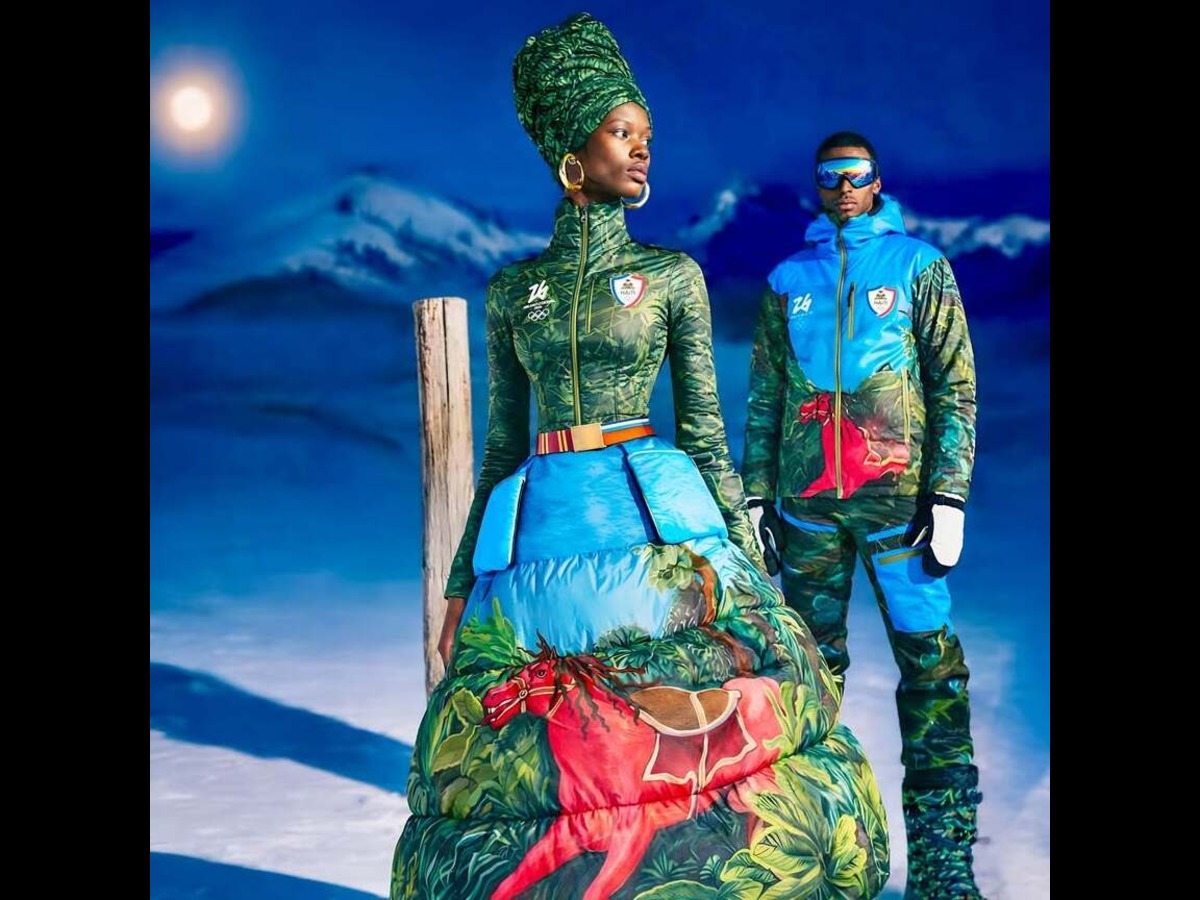
Haiti went to the Milan Cortina Winter Games with two athletes — Richardson Viano competing in alpine skiing and Stevenson Savart in cross-country skiing.
On Sunday, Savart, 25, made history as the first man to represent Haiti in cross-country skiing at the Winter Games. He made his Olympic debut in the men’s skiathlon, and as he crossed the finish line in 64th place, the crowd cheered.
In a video posted on Instagram, Savart said in French, “The goal is still to try and achieve the best possible performance and to push my limits. It’s an immense source of pride and great happiness to wear this outfit and we’re trying to be symbols for our small country.”


Certainly, the small and troubled country had already made history with its Olympic outfit ahead of the games. Designed by Italian-Haitian designer Stella Jean, the uniforms initially featured an image of Toussaint Louverture, the former slave who led a revolution that created the world’s first Black republic in 1804.
The International Olympic Committee (IOC), however, ruled that the image was against Olympic rules barring political symbolism, the AP reported. So, Jean had to quickly find a solution; that solution entailed painting over Louverture, who is widely considered the nation’s founding father.
Jean, who first designed Haiti’s uniforms for the 2024 Paris Games, said the Winter Olympics outfit was inspired by the painting of Louverture on a red horse by Haitian artist Edouard Duval-Carrié.
But after the IOC said the image of Louverture violated its rules, Jean had to engage some Italian artisans to hand-paint out the patriot’s figure, making history in the process as the only team with hand-painted uniforms at the games. The outfit now has the image of a charging red horse against a lush tropical background. On the back of it, “Haiti” is written against a blue sky.
Jean nearly gave up as she spent a year on the outfit, only for it to be rejected by the IOC at the last minute.
“For 24 hours, I said, ‘It’s over; they won’t have any uniform,’” she said to the Miami Herald. “But then I also thought that what brought us here was Haitian art, Haitian culture, Haitian excellence. So many human factors that helped us to be there.”
At the end of the day, the uniform design still preserves her message without distorting Haiti’s history.
“This painting has the two colors of the flag, red and blue,” Jean said. “You can immediately recognize it.”
“Rules are rules and must be respected, and that is what we have done,” Jean told the AP. “But for us, it is important that this horse, his horse, the general’s horse, remains. For us, it remains the symbol of Haiti’s presence at the Olympics.”
Jean didn’t leave the women in the delegation behind as she created a head wrap like a turban inspired by the Haitian tignon that enslaved African women were forced to wear by their French colonizers to cover their hair, to enforce racial hierarchy. The female design also featured skirts with pockets inspired by the outfits worn by Haiti’s street market vendors.
“Every single piece in this uniform has a specific historical meaning for it,” she said.
Haiti’s presence at the game is largely thanks to the financial support its athletes receive through the IOC’s Olympic Solidarity program to help with costs for equipment, training, and travel to qualification events, as reported by the AP.
Facing one of the most complex crises in its recent history, the Caribbean nation’s involvement in the Winter Olympics is not really about medals.
“Winter Olympics is a symbol, is a statement, not a coincidence,” Haiti’s ambassador to Italy, Gandy Thomas, told the AP. “We may not be a winter country, but we are a nation that refuses to be confined by expectation. … Absence is the most dangerous form of erasing.”
As Jean also wrote, “Haiti debuts at the Winter Olympics with what no crises can ever take from her: art. Creative powers. She steps onto the world stage of equal footing, with all nations — for in this arena, she is not subordinate to GDP.”