
Mary Mwangi is bringing hope to others with what kept her going when her world turned dark.
Mwangi, a lively woman who manages a tailoring business in Thika town, Kiambu County, Kenya, rediscovered her childhood hobby of knitting in 2017 while recovering from cancer treatment.
To occupy her time during the 11 months confined to bed after a spine cancer diagnosis, she knitted hats and later donated them to cancer patients at Kenyatta National Hospital. However, her life took a devastating turn in 2018 when she received a second diagnosis—stage-three breast cancer.
RELATED STORIES

The 52-year-old mother of three recounted to Al Jazeera how “terrified” she was upon hearing the diagnosis, stating, “I felt like it was the end of me when the diagnosis came out.”
After her diagnosis, she underwent a mastectomy—the surgical removal of part or all of a breast—and 33 radiotherapy sessions. This treatment lasted four years, during which she lost both her hair and her savings.
READ ALSO: The incredible story of a stage 4 triple-negative breast cancer survivor
The experience led her to isolate herself completely; she turned off her phone and cut off interaction with friends and family, telling her husband, “I don’t want to interact with anyone; the world felt so violent.”
The life-saving mastectomy led to social discrimination and stigma in her community, which is in central Kenya, about 40km (24.8 miles) northeast of Nairobi, the capital. This social devastation worsened the physical and financial hardship she was already facing.
“I had taken a 1.3-million-Kenyan-shilling (about $10,000) loan to expand my business as a tailor, and all was swept [away] by treatment,” she said, emphasizing her financial ruin.
After seeing other mastectomy patients trying to hide their chests and recognizing that support groups offer screening and counseling, but the public health system often lacks adequate cancer care and follow-up, Mwangi decided to take action.
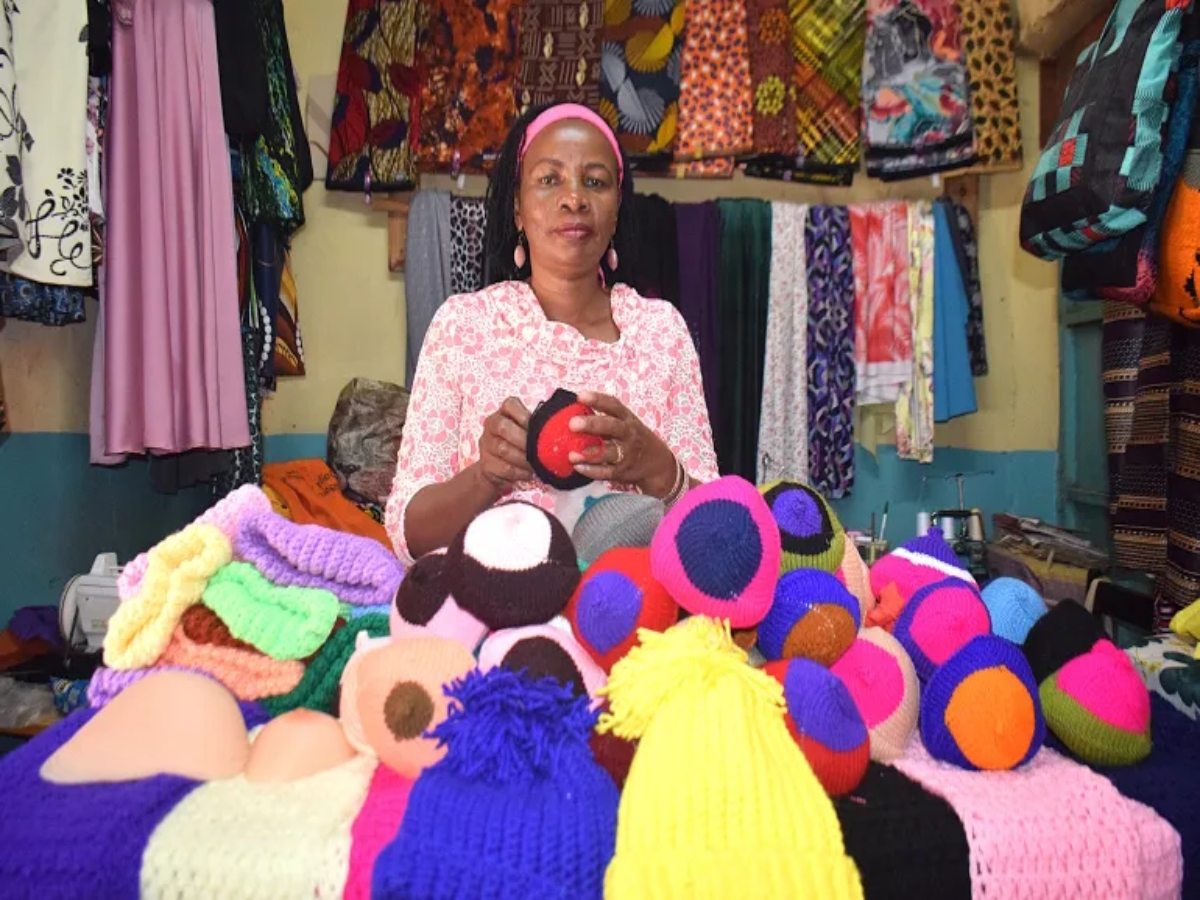
She merged knitting, which was her coping mechanism, with a business concept: creating colorful, knitted cotton yarn breast prostheses. This initiative supports survivors in their recovery while also generating income.
Mwangi learned to make yarn breast prostheses at a cancer support group, then improved her technique through YouTube tutorials and practice.
“Thank God for knitting. It was a form of simple therapy for me,” Mwangi said. “It took my mind away from thinking about [the cancer].”
Breast cancer is the most common cancer in women globally, affecting over 6,700 Kenyan women annually. After mastectomies, many seek prosthetic breasts. However, at an estimated 22,000 Kenyan shillings ($170), silicone prosthetics are unaffordable for many in Kenya, where over 40 percent of the population lives on less than $3 a day.
To make them affordable, Mwangi sells her knitted breast prostheses for 1,500 Kenyan shillings ($11.60) each. She produces around 50 of these prosthetics weekly and has sold approximately 600 to date. Additionally, she has sold over 450 knitted hats to cancer patients.
The prostheses come in various sizes and colors and are filled with yarn. They are designed to fit into specialized bras with pockets, which are sold separately for between 1,000 ($7.74) and 2,000 Kenyan shillings ($15.49) each.
She sells products directly for cash at her shop and secures bulk orders from partners like Milele Health, Kenyatta National Hospital, and the Childhood Cancer Initiative, which donate the items to survivors. This strategy helped her reestablish her business while continuing to support those in need.
Mwangi leads the New Dawn Cancer Warriors support group. She helps survivors regain their confidence by encouraging them and providing knitted prostheses.
Mwangi knits most of the prostheses herself. She, however, uses trained women for larger orders and has taught over 200 women to knit in her shop since January.
“Knitting has not only saved me, it has also given me purpose,” Mwangi remarked.
The workshops attract a diverse group, extending beyond breast cancer survivors to include individuals managing various other health issues.
Mwangi finds her work making prostheses for breast cancer survivors deeply rewarding, as it helps the women regain self-confidence after mastectomies.
However, she faces challenges, including limited workshop space (only four trainees at a time), financial constraints preventing her from officially registering as a training school, and increased yarn costs, which sometimes necessitate slightly raising product prices.
Despite the challenges, she maintains her optimism.
She expressed her desire “to train as many cancer survivors as possible in Kenya,” by training them. Ultimately, her goal is for each of them to establish their own independent business, providing them with the opportunity to “earn a living through knitting.”
READ ALSO: Mom receives master’s degree while battling stage 4 breast cancer